
The Rains Retreat and Kaṭhina: A Season of Dhamma, Practice and Generosity
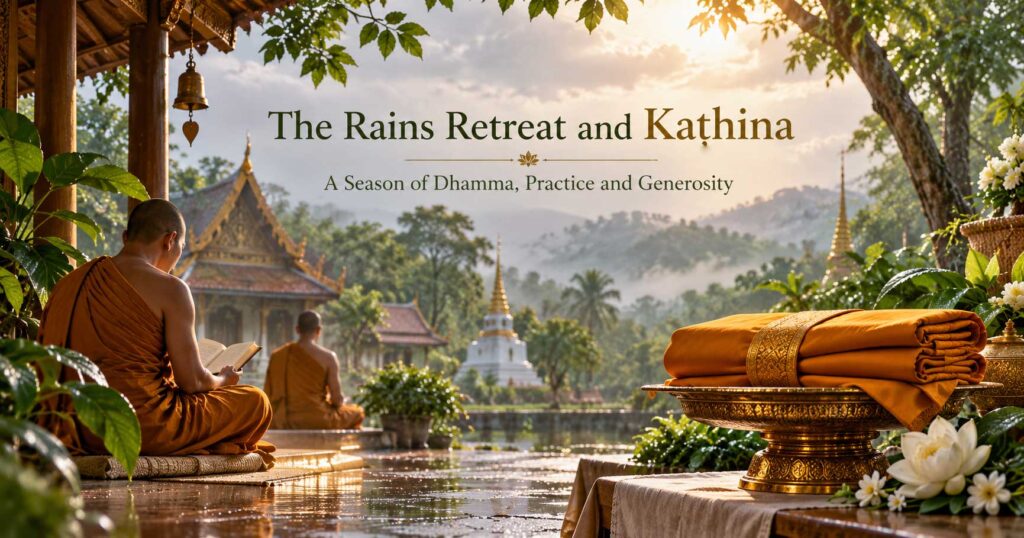
Each year, Buddhist communities across the world observe Vassa, the Rains Retreat, followed by the traditional Kaṭhina robe-offering ceremony. For Theravāda Buddhists, these observances form an important part of the living monastic tradition established through the Buddha’s Vinaya, the disciplinary framework governing the life of the Saṅgha.
Although Vassa and Kaṭhina developed within the monastic community, their significance extends well beyond monastic life. They bring together Dhamma study, meditation, ethical discipline, generosity and community, providing an opportunity for both monastics and lay Buddhists to renew their commitment to the Buddhist path.
Vassa: The Rains Retreat
The Pāli term ‘vassa’ means ‘rain’ or ‘rainy season’, while vassāvāsa refers to the residence undertaken during the rains. The Buddha established a period during which monks and nuns were to remain in one place rather than travelling continuously. The rules governing this practice are preserved in the Mahāvagga of the Vinaya Piṭaka (Mv. III).
The historical setting was ancient India, where the monsoon made travel difficult and where movement during the rainy season could cause harm to vegetation and small creatures. The Vinaya, however, does not present Vassa merely as a practical arrangement. Remaining together in one place also provided an important opportunity for training, instruction, meditation and communal discipline.
The importance of learning during the rains is beautifully illustrated in the Vassaṃvuttha Sutta (SN 55.52). A monk who has completed his rains residence is asked whether he ‘heard and learned’ anything while staying in the presence of the Buddha. His response concerns the Dhamma and the stages of liberation. The passage therefore illustrates how the rains residence could become a period of concentrated hearing, learning and deepening one’s understanding of Dhamma (SN 55.52).
This is particularly relevant to the Theravāda tradition, in which the Pāli Tipiṭaka has remained the principal textual foundation of Buddhist doctrine and monastic discipline. The Vinaya Piṭaka regulates communal monastic life, while the Sutta Piṭaka preserves teachings on ethics, meditation and wisdom.
Study and Meditation
Vassa therefore offers an opportunity for monks to deepen both pariyatti, learning or study of the Dhamma, and paṭipatti, putting the teaching into practice.Study without practice can remain merely intellectual; practice without adequate understanding can easily become confused. The Buddhist path brings understanding and practice together through ethical conduct, meditation and wisdom.
The Ānāpānassati Sutta (MN 118) presents mindfulness of breathing as a systematic practice through which mindfulness, concentration and insight are cultivated. Significantly, the discourse itself is situated at the end of a rains residence, when the Buddha praises the monks for their practice and encourages them to continue striving towards what has not yet been attained (MN 118).
For contemporary monks, therefore, the Rains Retreat can be a particularly valuable period for meditation, Pāli and Buddhist textual study, teaching, reflection and communal spiritual training.For lay Buddhists, Vassa can also become a season of renewed practice. One does not have to live in a monastery to participate in its spirit. Attending Dhamma teachings, establishing a regular meditation practice, reading the Buddha’s teachings, observing the precepts, cultivating generosity and supporting the Saṅgha are all meaningful ways of making the period spiritually significant.
The question Vassa presents to all of us is simple: How can we create more space in our lives for the Dhamma?
Pavāraṇā: Completing the Rains with Openness
The conclusion of Vassa is marked by Pavāraṇā, the ‘invitation’ by which monks invite one another to point out anything that they may have seen, heard or suspected concerning their conduct. The procedure is described in the Pavāraṇākkhandhaka of the Vinaya (Mv. IV).
The monk makes the invitation: ‘Diṭṭhena vā sutena vā parisaṅkāya vā vadantu maṃ bhante anukampaṃ upādāya.’
‘Venerable sirs, please speak to me out of compassion concerning what you have seen, heard or suspected.’
The principle behind Pavāraṇā is deeply relevant to Buddhist communities today. Spiritual development requires humility, honesty and the willingness to receive constructive correction. The purpose is not accusation but compassion: members of the Saṅgha help one another recognise shortcomings so that they may continue to develop in the Dhamma. The practice therefore reminds us that Buddhist spiritual life is not simply an individual pursuit. It takes place within a community of kalyāṇa-mittatā — spiritual friendship and mutual support.
What Is Kaṭhina?
Following the completion of the Rains Retreat, the Saṅgha may undertake the Kaṭhina ceremony. Its origins are recorded in the Kaṭhinakkhandhaka of the Vinaya (Cv. VII). The Vinaya tells of a group of monks who completed their rains residence and then travelled to visit the Buddha while the rains were still continuing. Their robes became soaked during the journey. In response, the Buddha established the Kaṭhina procedure, allowing the monks who had completed the rains to receive cloth and prepare a robe through a formal communal process (Cv. VII).
The word ‘kaṭhina’ originally refers to a frame or support used in the robe-making process. In the Vinaya tradition, however, it also comes to designate the special period and privileges associated with the completion of the Kaṭhina procedure. This is important because Kaṭhina is sometimes misunderstood simply as an annual occasion when laypeople give robes to monks. The canonical ceremony is more specific. The cloth is offered to the Saṅgha, and the Saṅgha undertakes the prescribed procedure through which the cloth is made into a robe and the Kaṭhina is formally established. Traditionally, the robe-making itself was an important communal activity requiring the monks to work together within a short period. Thus, Kaṭhina is simultaneously an act of lay generosity and monastic communal discipline.
The Meaning of the Robe Offering
The robe is one of the basic requisites (paccaya) upon which monastic life depends. The Buddha’s teachings repeatedly emphasise simplicity and freedom from attachment to material possessions. In the Ariyavaṃsa Sutta (AN 4.28), contentment with whatever robe-cloth is available is described as one of the ‘traditions of the Noble Ones’. The significance of Kaṭhina therefore does not lie in the material value of the robe. Rather, it lies in the intention behind the offering. For lay Buddhists, offering robes and other requisites is an expression of dāna, generosity. It provides an opportunity to cultivate gratitude and non-attachment while supporting those who have undertaken the monastic life.
For monastics, receiving such support carries an ethical responsibility. The Vinaya makes clear that the Saṅgha’s material dependence upon lay supporters is accompanied by a life of discipline, simplicity, study, meditation and service to the Dhamma. The Vinaya itself is designed not only to regulate individual conduct but also to sustain harmonious relationships between monastics and the lay community. Kaṭhina thus represents a reciprocal relationship: the laity support the Saṅgha materially, while the Saṅgha preserves, practises and teaches the Dhamma.
Vassa and Kaṭhina in Theravāda Buddhism
For Theravāda Buddhism, the importance of Vassa and Kaṭhina lies particularly in their connection with the Vinaya tradition preserved in the Pāli Canon. Theravāda communities in Sri Lanka, Thailand, Myanmar, Laos, Cambodia and elsewhere have maintained these observances in different cultural forms. Local customs surrounding Kaṭhina may vary considerably, but the underlying Vinaya framework comes from the ancient monastic tradition recorded in the Pāli texts.
It is therefore helpful to distinguish between the canonical foundation and the later cultural expressions of the ceremony. Processions, decorations, special meals, community celebrations and other customs may differ from country to country. The fundamental principles, however, remain rooted in the Vinaya: completion of the rains, communal discipline, robe-making, generosity and support for the Saṅgha. For a Theravāda Buddhist community in contemporary Oxford, this ancient tradition can therefore be understood not simply as a cultural inheritance from Sri Lanka or another Buddhist country, but as a living expression of the early Buddhist monastic tradition.
A Living Tradition for Today
Vassa and Kaṭhina continue to speak meaningfully to modern life. The Rains Retreat reminds us of the value of slowing down, remaining present and creating deliberate space for study, meditation and spiritual development. Pavāraṇā reminds us of the importance of humility, openness to correction and compassionate relationships. Kaṭhina reminds us that spiritual practice depends upon generosity and community. No Buddhist community exists entirely through individual effort. Monastics and laypeople sustain one another in different but complementary ways.
The Buddha’s teaching repeatedly places effort and personal practice at the centre of the path. As the Dhammapada (276) states:
‘Tumhehi kiccaṃ ātappaṃ; akkhātāro tathāgatā.’
‘You yourselves must make the effort; the Tathāgatas are only teachers.’
Vassa and Kaṭhina embody this principle in communal form. The Dhamma must be heard, studied, reflected upon and practised. Meditation must become part of lived experience. Generosity must support the conditions in which spiritual practice can flourish. And the community must help sustain the Dhamma from one generation to the next. The robe offered at Kaṭhina is therefore more than a piece of cloth. It represents a living connection between generosity and practice, study and meditation, monastic and lay life, and the ancient Buddhist tradition and its continuing presence in the modern world.
For the Oxford Buddhist Society, observing Vassa and Kaṭhina is an opportunity to participate in this long Theravāda tradition while making its values meaningful within the contemporary life of Oxford: to learn the Dhamma, to practise it, to support one another, and to cultivate a life directed towards wisdom, compassion and liberation.
Thank you!
With mettā,
Oxford Buddhist Society